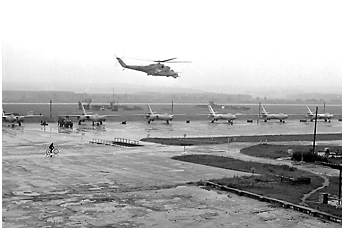
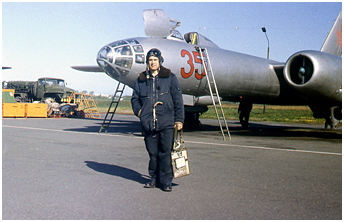
 Until the mid-1950s, towing targets was not necessarily a prerogative of units specialized in this task.
Two situations coexisted. On the one hand, the fighter or ground attack units towed banners or windsocks with their own first line aircraft
and, on the other hand, some regiments such as the 931.OKRAP or the 48.OGRAP had a target-towing squadron or section that
interacted essentially with the anti-aircraft artillery. To learn more about these activities and much more, read the very detailed study entitled "Flight Logs"
by clicking the link under this paragraph.
In 1954, a target-towing section would have been created within the 277.BAP from Brand. Based at Parchim from the end of July, the Il-28s of this section
were however maintained at Brand. This unit is believed to be the forerunner of the 74.OBAE (Otdel'naya Buksirovochnaya Aviatsionnaya Eskadriliya)
that remained stationed at Parchim until January 1982 when the squadron was transferred to Damgarten.
In May 1956, it was 65.OBAE's turn to be set up in Oranienburg on the basis of an unidentified towing section also flying Il-28s.
The squadron moved to Stendal in 1958 and returned to Oranienburg in December 1971. Finally, the 65.OBAE joined Damgarten in September 1977.
Until the mid-1950s, towing targets was not necessarily a prerogative of units specialized in this task.
Two situations coexisted. On the one hand, the fighter or ground attack units towed banners or windsocks with their own first line aircraft
and, on the other hand, some regiments such as the 931.OKRAP or the 48.OGRAP had a target-towing squadron or section that
interacted essentially with the anti-aircraft artillery. To learn more about these activities and much more, read the very detailed study entitled "Flight Logs"
by clicking the link under this paragraph.
In 1954, a target-towing section would have been created within the 277.BAP from Brand. Based at Parchim from the end of July, the Il-28s of this section
were however maintained at Brand. This unit is believed to be the forerunner of the 74.OBAE (Otdel'naya Buksirovochnaya Aviatsionnaya Eskadriliya)
that remained stationed at Parchim until January 1982 when the squadron was transferred to Damgarten.
In May 1956, it was 65.OBAE's turn to be set up in Oranienburg on the basis of an unidentified towing section also flying Il-28s.
The squadron moved to Stendal in 1958 and returned to Oranienburg in December 1971. Finally, the 65.OBAE joined Damgarten in September 1977.
| Flight Logs |
 Un Yak-25RV-I photographié à Zerbst en février 1966. © BRIXMIS
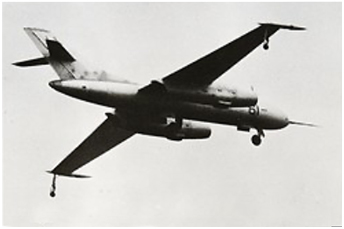
A Yak-25RV-1 photographed at Zerbst in February 1966. © BRIXMIS
 We must also address the specific case of the Yak-25RV "Mandrake." This Soviet response to the Lockheed U-2 was employed in its RV-I version as a target
for the fighter pilots training to intercept hostiles flying at very high altitude.
Some aircraft were delivered to the 24.VA for this purpose, but they were assigned to fighter units.
That was a logical decision to ensure these aircraft were properly maintained, since the first were delivered in 1962 to the 773.IAP at Damgarten while a squadron
of Yak-25M "Flashlight" was operational there. The Yak-25RV-I were consolidated into a flight(zveno) in 1963 and the 1966 USMLM Annual History that
included a 24.VA order of battle, mentioned the presence of six "Mandrakes" at Damgarten.
We must also address the specific case of the Yak-25RV "Mandrake." This Soviet response to the Lockheed U-2 was employed in its RV-I version as a target
for the fighter pilots training to intercept hostiles flying at very high altitude.
Some aircraft were delivered to the 24.VA for this purpose, but they were assigned to fighter units.
That was a logical decision to ensure these aircraft were properly maintained, since the first were delivered in 1962 to the 773.IAP at Damgarten while a squadron
of Yak-25M "Flashlight" was operational there. The Yak-25RV-I were consolidated into a flight(zveno) in 1963 and the 1966 USMLM Annual History that
included a 24.VA order of battle, mentioned the presence of six "Mandrakes" at Damgarten.
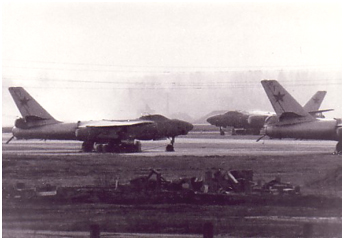
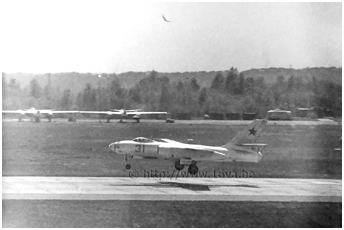
But that was already outdated information, because in 1965, most of the Yak-25M and Yak-25RV-I aircrews as well as the technical personnel and probably most of the aircaft
moved to Zerbst certainly in order to prepare for the arrival of the new Yak-28P "Firebar" in the 35.IAP, scheduled for 1966. The fact is that at least three Yak-25RV-I
were observed and photographed at Zerbst in 1966 and 1967.
From 1982 on, when the 74.OBAE also moved to Damgarten, all 16.VA target-towing assets were concentrated on a same airbase
organized into two separate squadrons. Subordinate to the 16.VA, each squadron was composed of 12 Il-28s.
The consolidation of the target-towing units at Damgarten was a rational decision as the Baltic Sea ground-to-air and air-to-air ranges were situated nearby.
The latter firing range also was used by VVS units based in other Warsaw Pact countries that regularly deployed to Damgarten for gunnery training.
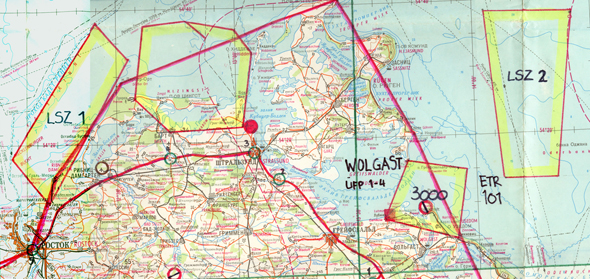
 No less than five Soviet and East German firing ranges were spread along the Baltic Sea coasts.
The westernmost polygon was a Soviet firing range located at Wustrow, east of Rostock. It was
essentially used for anti-aircraft artillery and SAM systems personnel training.
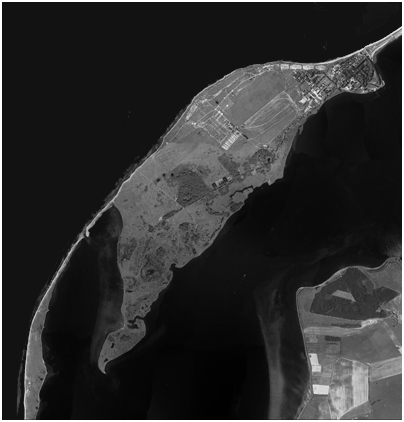
Further east, off Damgarten and Barth, the Zingst peninsula was home to a NVA range designated "Air firing area N°1"
(Luftschießzone I - LSZ I) that was divided into two sectors. The first was located in Zingst (Gefechtsstand 1 ) - to the east
- and the second one in the "Mecklenburger Bucht" (Gefechtsstand 2 ) - to the west.
Direct firing by the flak against targets towed by LSK/LV Il-28s (which were later replaced by L-39V) and An-2 took place in the western sector.
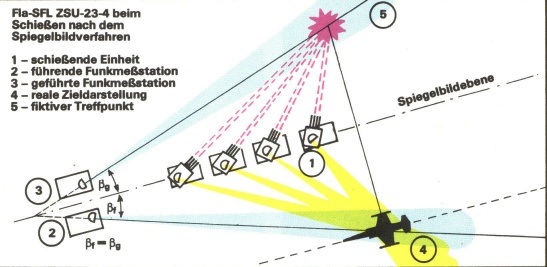
MiG-21 and MiG-23 also were used as "mirror" targets (1) in the eastern sector.
The latter, which housed the living area, after 1974 also became the duty station of a training unit for
SAM systems personnel, the FRAZ 40 (Fla-Raketenausbildungszentrum - Anti-Aircraft Missile Training Center).
Atmospheric probe rockets also were launched from there beginning in the early seventies (the last one was fired on April 10, 1992).
No less than five Soviet and East German firing ranges were spread along the Baltic Sea coasts.
The westernmost polygon was a Soviet firing range located at Wustrow, east of Rostock. It was
essentially used for anti-aircraft artillery and SAM systems personnel training.
Further east, off Damgarten and Barth, the Zingst peninsula was home to a NVA range designated "Air firing area N°1"
(Luftschießzone I - LSZ I) that was divided into two sectors. The first was located in Zingst (Gefechtsstand 1 ) - to the east
- and the second one in the "Mecklenburger Bucht" (Gefechtsstand 2 ) - to the west.
Direct firing by the flak against targets towed by LSK/LV Il-28s (which were later replaced by L-39V) and An-2 took place in the western sector.
MiG-21 and MiG-23 also were used as "mirror" targets (1) in the eastern sector.
The latter, which housed the living area, after 1974 also became the duty station of a training unit for
SAM systems personnel, the FRAZ 40 (Fla-Raketenausbildungszentrum - Anti-Aircraft Missile Training Center).
Atmospheric probe rockets also were launched from there beginning in the early seventies (the last one was fired on April 10, 1992).
 There was a third smaller firing range near Peenemünde airbase. One can still find today
in the "Peenemünder Haken," near the coast, boat wrecks
(including decommissioned landing craft from the East German Navy) that formerly were used as targets by the different NVA air components.
Furthermore, these targets were used during Warpac exercises such as "Waffenbrüderschaft 80," when the ships were attacked by heavy bombers
coming from the Soviet Union. Let's mention another small air-to-ground firing range that was located nearby. The latter was used by the
aircraft of the JG-9 based at Peenemünde. The range was situated east, between the airfield and the coast.
A fourth polygon designated Luftschießzone II (LSZ II) located east of the Rügen island, was exclusively dedicated to air-to-air firing.
It was accessible to Soviet fighter aircraft (2), LSK/LV aircraft
as well as those of the Czechoslovak People's Army Air Force, which sent aircraft there several times each year (check the "Zóně Balt" link on this page).
The fifth range was reserved for the training of Soviet Navy gunners - less appreciated by the target-towing aircraft crews
because of their propensity to open fire too soon - and those of the East German Navy. It was located between the Polish town of Swinoujscie (Swinemünde)
to the north, right on the border with East Germany and Ueckermünde to the south.
There was a third smaller firing range near Peenemünde airbase. One can still find today
in the "Peenemünder Haken," near the coast, boat wrecks
(including decommissioned landing craft from the East German Navy) that formerly were used as targets by the different NVA air components.
Furthermore, these targets were used during Warpac exercises such as "Waffenbrüderschaft 80," when the ships were attacked by heavy bombers
coming from the Soviet Union. Let's mention another small air-to-ground firing range that was located nearby. The latter was used by the
aircraft of the JG-9 based at Peenemünde. The range was situated east, between the airfield and the coast.
A fourth polygon designated Luftschießzone II (LSZ II) located east of the Rügen island, was exclusively dedicated to air-to-air firing.
It was accessible to Soviet fighter aircraft (2), LSK/LV aircraft
as well as those of the Czechoslovak People's Army Air Force, which sent aircraft there several times each year (check the "Zóně Balt" link on this page).
The fifth range was reserved for the training of Soviet Navy gunners - less appreciated by the target-towing aircraft crews
because of their propensity to open fire too soon - and those of the East German Navy. It was located between the Polish town of Swinoujscie (Swinemünde)
to the north, right on the border with East Germany and Ueckermünde to the south.
Wustrow Restricted Area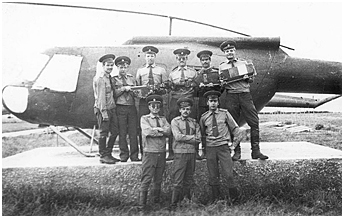
 The Wustrow Peninsula already had become a AAA training site back in 1934.
A grass airfield 1000 meters long and 1000 meters wide that included a slipway for floatplanes was also developed.
The target-towing aircraft were Junkers W34 equipped with floats and Ju-52s.
The site again was used for the same purpose by the Soviets after the war.
A coastal artillery unit was based at Wustrow until the late 1950s. Moreover, the NVA
also practiced AAA firing from the peninsula before moving these activities to Zingst towards the end of the decade.
Some Li-2s were observed in 1959 and they probably were employed to tow targets.
Anyway, the aerodrome became inactive in the following years. On the other hand, a helicopter landing point
(N°253) was created. Curiously, nearly 20 aircraft and helicopter decoys were deployed on the former airfield.
It is likely that some of them were mock-ups of NATO aircraft used to instruct conscripts. This kind of
mock-ups representing aerial or terrestrial equipments, could indeed be found on several training ranges.
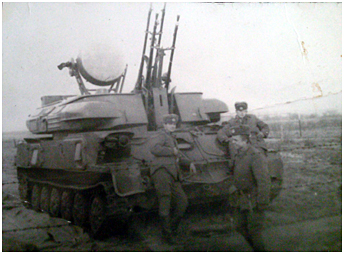
In addition to conventional anti-aircraft guns, tracked anti-aircraft armored vehicles (ZSU-27, ZSU-23-4)
also were training at Wustrow. The guns were aimed both at air (towed targets, PM-6), ground or sea targets.
In the latter case, the targets were towed by boats that sometimes sailed up to eight kilometers offshore.
All maritime traffic was prohibited in the area within 15 km.
The Wustrow Peninsula already had become a AAA training site back in 1934.
A grass airfield 1000 meters long and 1000 meters wide that included a slipway for floatplanes was also developed.
The target-towing aircraft were Junkers W34 equipped with floats and Ju-52s.
The site again was used for the same purpose by the Soviets after the war.
A coastal artillery unit was based at Wustrow until the late 1950s. Moreover, the NVA
also practiced AAA firing from the peninsula before moving these activities to Zingst towards the end of the decade.
Some Li-2s were observed in 1959 and they probably were employed to tow targets.
Anyway, the aerodrome became inactive in the following years. On the other hand, a helicopter landing point
(N°253) was created. Curiously, nearly 20 aircraft and helicopter decoys were deployed on the former airfield.
It is likely that some of them were mock-ups of NATO aircraft used to instruct conscripts. This kind of
mock-ups representing aerial or terrestrial equipments, could indeed be found on several training ranges.
In addition to conventional anti-aircraft guns, tracked anti-aircraft armored vehicles (ZSU-27, ZSU-23-4)
also were training at Wustrow. The guns were aimed both at air (towed targets, PM-6), ground or sea targets.
In the latter case, the targets were towed by boats that sometimes sailed up to eight kilometers offshore.
All maritime traffic was prohibited in the area within 15 km.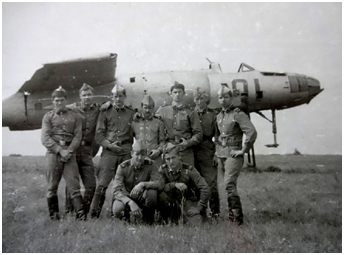
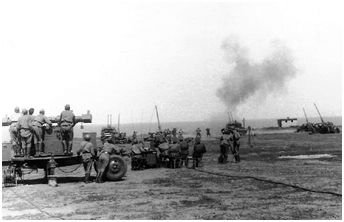 A training track for armored vehicles and an exercise area for the infantry also were located there.
In addition, Wustrow subsequently also became a training center for SAM system personnel.
It would seem that Wustrow beaches were used in amphibious training exercises.
Upon withdrawal from Germany, landing craft also were used to evacuate material.
The living area was established at Rerik, east of the peninsula.
A training track for armored vehicles and an exercise area for the infantry also were located there.
In addition, Wustrow subsequently also became a training center for SAM system personnel.
It would seem that Wustrow beaches were used in amphibious training exercises.
Upon withdrawal from Germany, landing craft also were used to evacuate material.
The living area was established at Rerik, east of the peninsula.Various elements of the Baltic Fleet were also stationed in Rerik-Wustrow from 1946 on until the end. The core was composed of units controlling maritime traffic - especially after the war, when minefields were still present. A separate enclosure with its own fences and a guardhouse, was lit at night. It housed the Navy facilities: barracks, radars, radios and beacons. It was also probably a support facility for Electronic Intelligence activities. The dark side of Wustrow did not end there. The Second Special Reconnaissance Brigade of Soviet military intelligence or GRU, also took up residence at Wustrow. Essentially from Rote Plätze by S.Büttner and L.Freundt (AeroLit) & Die verbotene Halbinsel Wustrow by Edelgard and K.Feiler (Ch.Links). |
| Wustrow Photo Page |
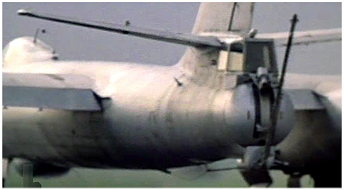 Cette photo extraite du film "Tri Portsenka Riska" tourné à Kolomya en 1984, nous permet d'observer la perche (courte) de remorquage d'un Il-28.
Les canons NR-23 de la tourelle de queue étaient déposés.
Cette photo extraite du film "Tri Portsenka Riska" tourné à Kolomya en 1984, nous permet d'observer la perche (courte) de remorquage d'un Il-28.
Les canons NR-23 de la tourelle de queue étaient déposés.
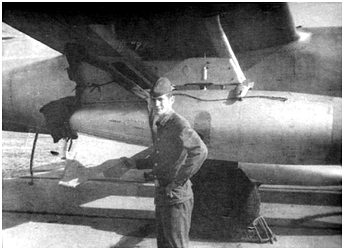
Close up on the short towing boom of an Il-28.
The NR-23 tail turret guns were removed. That picture is extracted from the movie "Tri Portsenka Riska" shot in Kolomya in 1984.
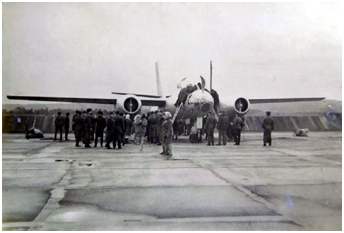 Il-28 Buksirovshchik Misheney (Il-28 Target Tug - they were never designated Il-28BM) that flew for the benefit
of the ground and air forces, were modified bomber or reconnaissance versions. The latter Il-28R had wingtip-mounted tanks.
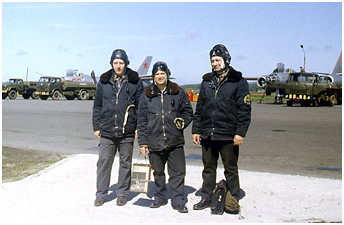
Target-towing "Beagle" crew composition was similar to that of other Il-28s: a navigator
(Shturman) in the glazed nose, a pilot (Pilot) and the aerial gunner-radio operator
(Vozdushnyy Strelok-Radist) who monitored the towing system.
Il-28 Buksirovshchik Misheney (Il-28 Target Tug - they were never designated Il-28BM) that flew for the benefit
of the ground and air forces, were modified bomber or reconnaissance versions. The latter Il-28R had wingtip-mounted tanks.
Target-towing "Beagle" crew composition was similar to that of other Il-28s: a navigator
(Shturman) in the glazed nose, a pilot (Pilot) and the aerial gunner-radio operator
(Vozdushnyy Strelok-Radist) who monitored the towing system.
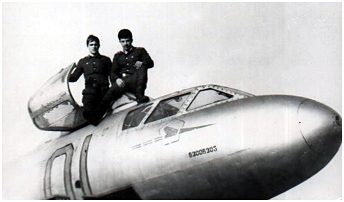 We do not know the technical provisions of these planes when they towed banners or windsocks as was the case in the fifties.
However, in order to be able to tow more complex targets, they had to carry inside their bomb bay a BLT-5 or a BLM-1000M winch.
They could winch a cable of 1800 meters long with a diameter of 5 mm or a 3 mm cable 4000 meters in length.
Damgarten aircraft usually deployed a cable 1000 or 1800 meters in length. A cable cutter was mounted
inside the bomb bay and was used if the damaged target could not be winched back safely.
During the 1980s, the Damgarten-based Il-28s had a long boom articulated below the unarmed tail
turret. During takeoff and landing, that rigid link was used to tow either a 7BM-2M target looking like a big dart
or a PM-3Zh target with long straight wings positioned at the rear of a pointed fuselage with a large squared vertical tail.
The target then was disconnected from the boom in flight and towed by the cable. It has been reported that
modified Il-28R models had a longer boom, but that was probably related to the type of target being towed.
Those targets were used for ground-to-air gunnery.
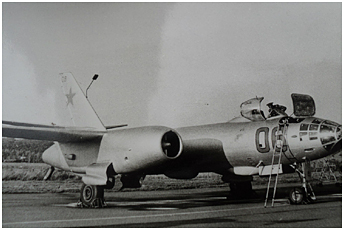
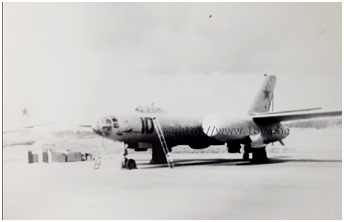
However, aircraft equipped with a towing pole were rare. Only one Il-28 (bort number 08) was identified with the 65.OBAE.
We do not know the technical provisions of these planes when they towed banners or windsocks as was the case in the fifties.
However, in order to be able to tow more complex targets, they had to carry inside their bomb bay a BLT-5 or a BLM-1000M winch.
They could winch a cable of 1800 meters long with a diameter of 5 mm or a 3 mm cable 4000 meters in length.
Damgarten aircraft usually deployed a cable 1000 or 1800 meters in length. A cable cutter was mounted
inside the bomb bay and was used if the damaged target could not be winched back safely.
During the 1980s, the Damgarten-based Il-28s had a long boom articulated below the unarmed tail
turret. During takeoff and landing, that rigid link was used to tow either a 7BM-2M target looking like a big dart
or a PM-3Zh target with long straight wings positioned at the rear of a pointed fuselage with a large squared vertical tail.
The target then was disconnected from the boom in flight and towed by the cable. It has been reported that
modified Il-28R models had a longer boom, but that was probably related to the type of target being towed.
Those targets were used for ground-to-air gunnery.
However, aircraft equipped with a towing pole were rare. Only one Il-28 (bort number 08) was identified with the 65.OBAE.
 Quelques cibles PM-6 de la NVA furent testées par la Luftwaffe. Celle-ci était accrochée sous l'aile d'un F-4F
du centre d'essais de Manching. © WTD 61.
Quelques cibles PM-6 de la NVA furent testées par la Luftwaffe. Celle-ci était accrochée sous l'aile d'un F-4F
du centre d'essais de Manching. © WTD 61.
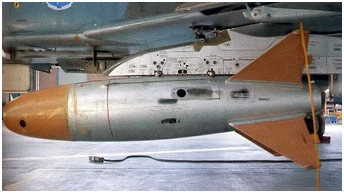
Some former NVA PM-6 targets were tested by the Luftwaffe.
This one is seen under the wing of a F-4F of the Manching test center. © WTD 61.
"Beagle" could also carry PM-6R and PM-6G diving targets mounted underwing.
Those reusable targets weighing 141 kg were 3M74 long for a wingspan of 1M14.
Although looking like bombs with enlarged fins, they were used to simulate diving bombers
and glide bombs and were equipped with smoke tracers to improve their visibility. The target's reflective surface equated
to that of a MiG-17 aircraft.
The PM-6 usually was launched from an altitude of 6000-8000 meters and dove at an angle of
35-70°. The flight speed of the target in the engagement sector was 200-220 meters per second (720-790 km/h), and
flight time prior to recovery parachute opening at an altitude of 750-1000 meters was 40-45 seconds.
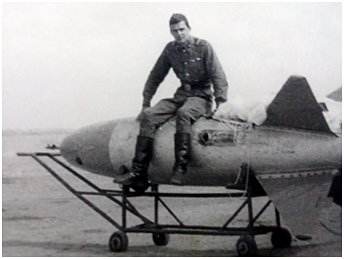 Une cible PM-6 repêchée dans la Mer Baltique. On remarquera le parachute. © A.Tchabanov.
A PM-6 target recovered from the Baltic Sea. Note the parachute. © A.Chabanov.
 The practice of air-to-air cannon firing for fighters after the 1950s is not really documented and remains an enigma. At most, it can be said
that the fighter units carried out firing camps at Mary in Turkmenistan.
The practice of air-to-air cannon firing for fighters after the 1950s is not really documented and remains an enigma. At most, it can be said
that the fighter units carried out firing camps at Mary in Turkmenistan.
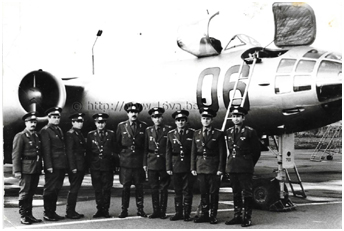
It is time to address the specific case of the Il-28PP of the 65.OBAE (see table below and photos above). First, the designation PP for
Postanovschik-Pomekh or Jammer, is the one given by former members of the unit. However, there was at least another aircraft with a different
configuration also designated Il-28PP. The Il-28PP of the 65.OBAE could easily be identified by the second radome, identical to that of the radar under the nose,
located at the level of the bomb bay that consequently was rendered useless.
According to some testimonies, a separate flight (zveno - OAZ) equipped with Il-28PP existed within the 11.ORAP at Welzow. These aircraft would have joined the ranks
of the 65.OBAE in Oranienburg during the summer of 1973 when the flight was disbanded. Nevertheless, they would not have been used as ECM platforms, but simply as
virtual targets for the AAA. Anyway, they would have been unable to drop targets without wing pylons.
Note that similar aircraft also were on strength with each of the target-towing sections based in Poland (5.OBAZ) and Hungary (8.OBAZ).
| Organigramme 65.OBAE - 65.OBAE organization |
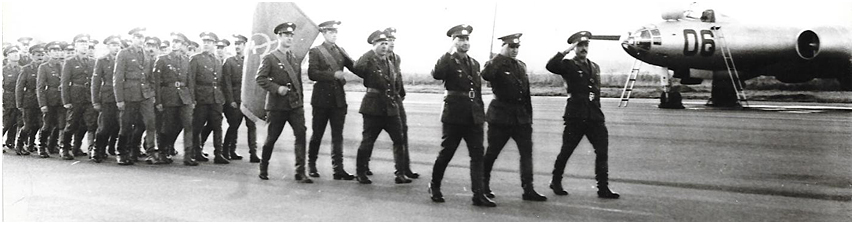 Défilé du personnel du 65.OBAE à Damgarten. © DR.
65.OBAE parade at Damgarten. © DR.
| 65.OBAE aircraft, early 1980s | |||
|---|---|---|---|
| Type | Bort | s/n | Airbases chronology |
| Il-28PP | 03 | Welzow - Oranienburg - Damgarten | |
| Il-28U | 04 | Oranienburg - Damgarten | |
| Il-28PP | 06 | 55007155 | Welzow - Oranienburg - Damgarten |
| Il-28U | 07 | 56009601 | Welzow - Oranienburg - Damgarten |
| Il-28 | 08 | Oranienburg - Damgarten | |
| Il-28 | 09 | Oranienburg - Damgarten | |
| Il-28PP | 10 | 55007160 | Welzow - Oranienburg - Damgarten |
| Il-28 | 11 | 55006542 | Oranienburg - Damgarten |
| Il-28 | 12 | Damgarten | |
| Il-28 | 14 | Damgarten | |
| Bort numbers were red with a black outline | |||
notes
(1)
The target aircraft was detected by the firing unit radar. A second radar repeated this radar echo
of the target with different coordinates. It is towards this second fictive or mirror echo that shells or missiles were fired. A special device
permitted to assess whether the target had been hit. Schematic diagram >
HERE.
(2)
Soviet units based in Warsaw Pact countries were sometimes deployed to Damgarten for firing training.
Known exemples are the 114.IAP from Milovice (CSFR) on MiG-23M and the 515.IAP from Tököl (Hungary) operating the MiG-21bis in 1984.
4.VA aircraft from Poland were more regular visitors of the range (they did not land in Damgarten):
- 159.GvIAP "Novorossiysk" from Stargard-Kluczewo (Mig-21MF then Su-27 in May 1987)
- 582.IAP from Chojna (Mig-21SMT then Su-27 in 1989-1990)
- 871.IAP from Kolobrzeg-Bagicz (MiG-23M), transferred to Brzeg and reequipped with MiG-23MLD
The range was controlled from Barth (callsign Model). When the range was used by the Czechoslovakians, a controller
of the same nationality was on duty. An Antonov 26 of the 226.OSAP operating from Damgarten for the occasion, was responsible for range security.
The 82 Aviatsionniy Poligon (Aviation Range) was the unit responsible for the range management.
 |
The target-towing units > Part 2 |
 |
Plan du site - Sitemap |  |

